| Sleuthound |
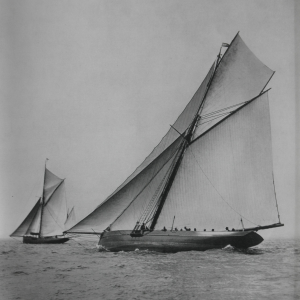 |
| Rig Class. | Cutter |
| Builder: | Fife |
| Year built: | 1881 |
| General characteristics |
| Ton: | 45 tons TM |
| LOA: | 68.45 feet |
| Beam: | 9.6 feet |
| Draught: | 9.6 feet |
Sleuthhound was built by Fife at Fairlie to a design by Fife Jnr for the Marquis of Ailsa, and she marked the last of the development of the old straight-stemmed 40-tonners who traced their ancestry directly back to the Navy, the Preventive Service and Pilots - the prosecuters and the policemen of fishermen.
Sleuthhound was the third of the Marquis's 'hounds', coming after the first Foxhound and then Bloodhound.
She was built in 1881 and there were two other new 40-tonners that year, the Fife yacht Annasona and the G L Watson designed May. All three were of narrower beam and greater displacement than yachts such as Norman which was the most successful of the existing boats at the time. All three were much faster vessels. Annasona proved to be the best of the new bunch and Sleuthhound was rather disappointing, although Annasona had a particularly fine helmsman in O'Neill.
1882 saw the introduction of the new YRA Tonnage Rule which, in fact, was no better than the rule it replaced. Annasona was still the crack boat in the class that year with Sleuthhound second. In 1883 Annasona didn't have O'Neill at the helm and was displaced by May; Sleuthhound was bottom of the league.
In 1887 the Tonnage Rule was dropped in favour of a new Sail Area Rule.
Also in 1887 the Royal Thames Yacht Club presented a handsome prize of 1,000 guineas for a race around Great Britain and Ireland to commemorate Queen Victoria's jubilee. The sailing distance was 1,600 miles and it lasted over 14 days. Genesta won, and Sleuthhound was second.
In the photo opposite, note the headgear above the bulwarks in the stern sheets. One appears to be a 'wide-awake' and the other a 'Billy-cock' or bowler.
Owners